
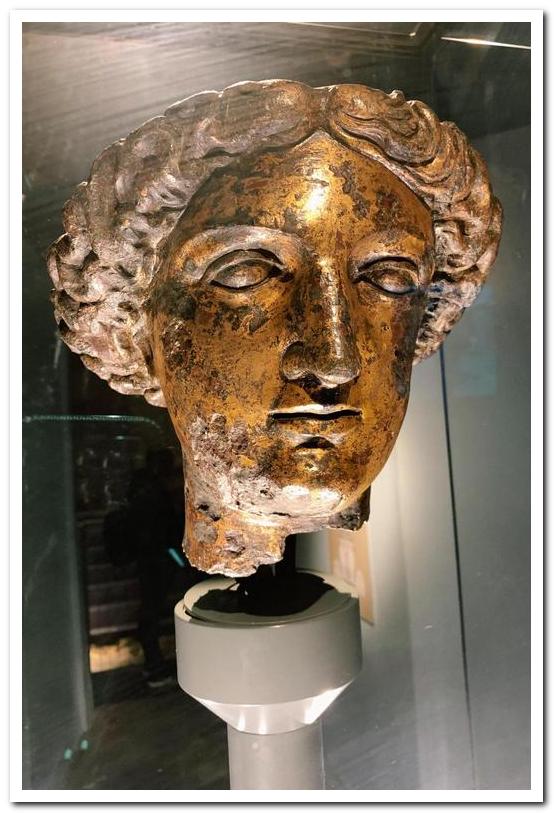
Above: gilded bronze head depicting the goddess Sulis Minerva unearthed in Bath in 1727.
I grew up not a million miles away from Bath and have visited it many times. As the Offspring has become fascinated with Roman history, we had a pilgrimage there a couple of months ago. I’d forgotten a lot of it, but not its absolute glory – what a place! The face above is mesmerising ‘in the flesh’. I could stand in front of her for hours, but as it is, you get jostled and harrumphed all around if you visit on school half-term week (fools!!). A swift pass with a sighing ‘ooh, isn’t she lovely?!’ is all we got.
Back home I had a root around the internet regarding Sulis Minerva, not knowing much about her. The head/face above likely formed part of a cult statue located within her temple beside the sacred spring, around which the Roman baths were built. It’s suggested the statue may have stood opposite the sacrificial altar across the temple courtyard. It is thought to date back to the establishment of the Roman settlement in the late first century CE. In ancient Celtic Britain, Sulis was a goddess honoured at these hot springs. After the Romans arrived, she became amalgamated with the Roman goddess Minerva, and together they were worshipped as ‘Sulis Minerva’.
Artefacts and inscriptions dedicated to her (also on display in Bath) suggest that people understood her in two different roles, namely as a benevolent goddess linked with healing, wellbeing, and renewal, and also as a powerful deity who could lay curses on wrongdoers when worshippers sought justice or revenge. Take your pick, as needed!
I was surprised when my Sulis Minerva research flagged up a load of old door knockers. Delving deeper, there were lots of reclaimed knockers on that well-known auction site, although a rummage revealed them to be attributed to all sorts of gods, goddesses and mythological beings, despite the same recognisable face based on the statue in Bath. It’s the way the eyes slant down at the outside corners…
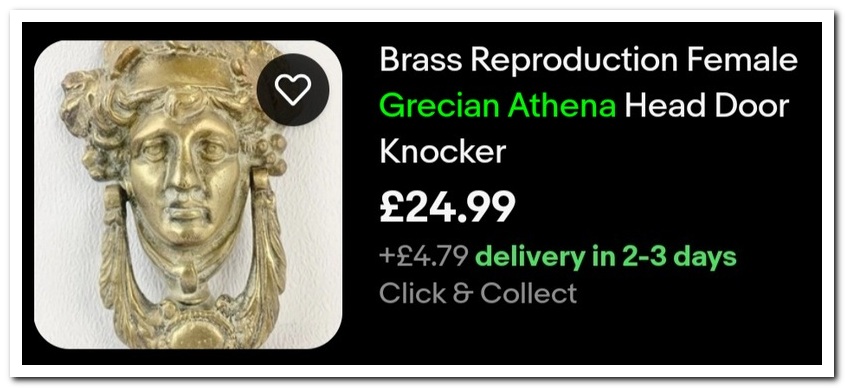
ATHENA: OK, Minerva was linked by the Romans to the ancient Greek goddess of wisdom, strategic warfare, and handicrafts, so that’s acceptable.
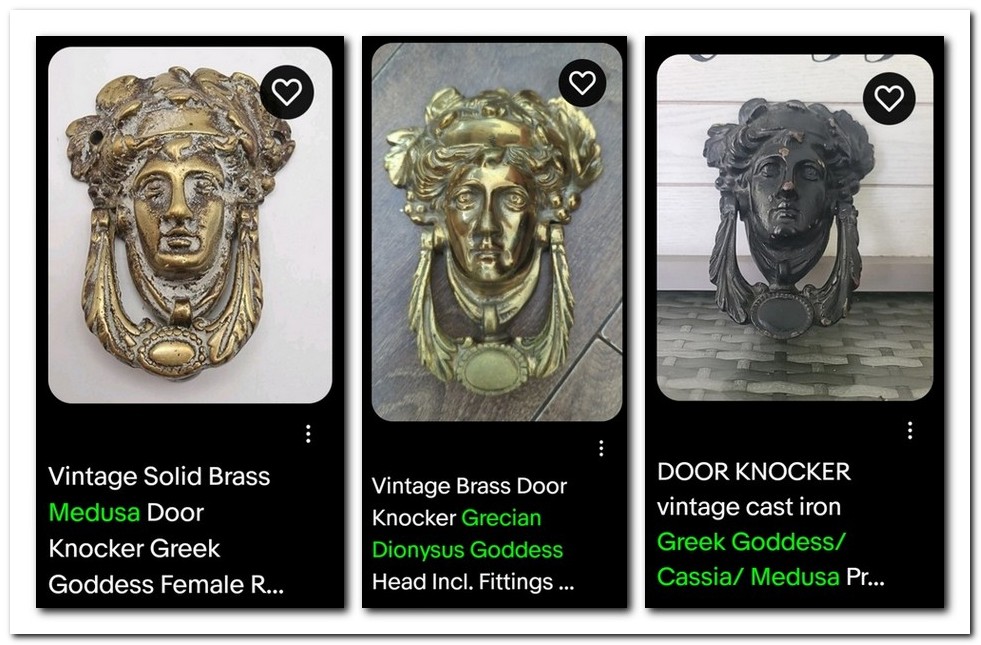
MEDUSA: not a goddess, known for that horrendous snek up-do… just NO. There are no sneks on this door knocker, just lots of lovely fruit and flora, so I don’t know how they came to this conclusion.
DIONYSUS: for starters, not a goddess and I think this would make him cross. He’s the god of the grape harvest, winemaking, fertility, orchards and insanity (should’ve had some water with it)
CASSIA: I couldn’t find a goddess called Cassia. The internet said:
Based on current research, there is no major, traditional deity named Cassia in classical Greek or Roman mythology, but the name appears in several modern, fictional, or specific niche contexts. Would the 2026 nerds and geeks see a brass door knocker as viable merch? Actually – maybe?
Victorians admired Sulis Minerva door knockers as they reflected the period’s enthusiasm for classical mythology, idealized history, and richly decorative symbolism in the home. Typically crafted from brass or iron, these knockers symbolized wisdom, protection, and a link to ancient Roman-Celtic traditions, functioning both as striking ornamental features and as fashionable emblems believed to safeguard the household. From outside, Sulis Minerva was therefore intended to signify a scholarly or refined household.
Well, I had to have one. Here she is, slanty eyes and all. I don’t have a suitable door to put her on, but will squirrel her away into my collection of Victorian oddities.
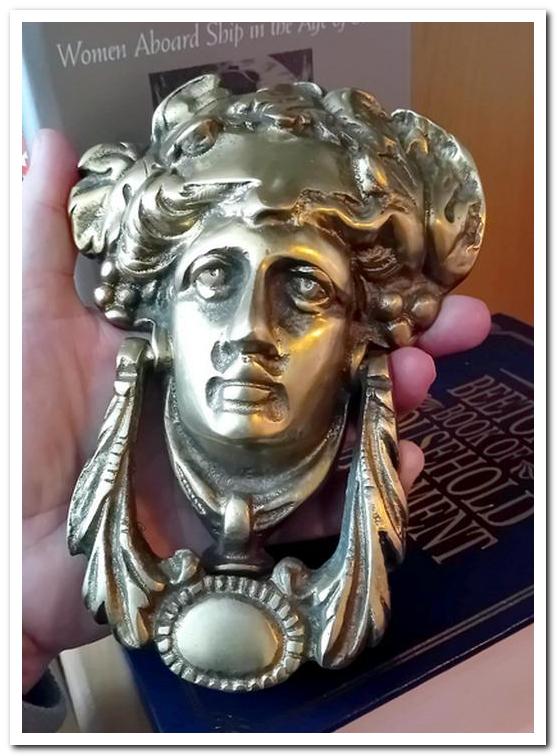
Incidentally, whilst walking through the delightful Kent village where the Offspring lives, full of typical Victorian (and older) white weatherboarded cottages, I spotted three Sulis Minerva knockers in situ, obviously still being used on a daily basis. You could go knocker spotting too! I do it everywhere I go now 😃
Quick query. With the attributes of gods and goddesses, after two or three mighty things, why is there frequently something a bit silly? Like… Jacqualacka, goddess of history, seas, trees and custard doughnuts. What would yours be? 🤔 x

 Jacqueline Day
Leave a comment